From Mother to Daughter

My photo
Festivals are social events to grow spiritualy involving cooking and eating with family and friends. Cooking is an evolving art, wing thru a recipe and whip up your own concoction.

Thursday, December 19, 2013

Raagi Muddae/Kali/Dumpling

Prep

Ragi Muddae/Kali/Dumpling

Ingredients:

  • 1 cup ragi flour
  • 1 tsp oil (olive, canola or can be ghee)
  • pinch of salt to taste
  • 2 cups water

Method:

Starting to cook
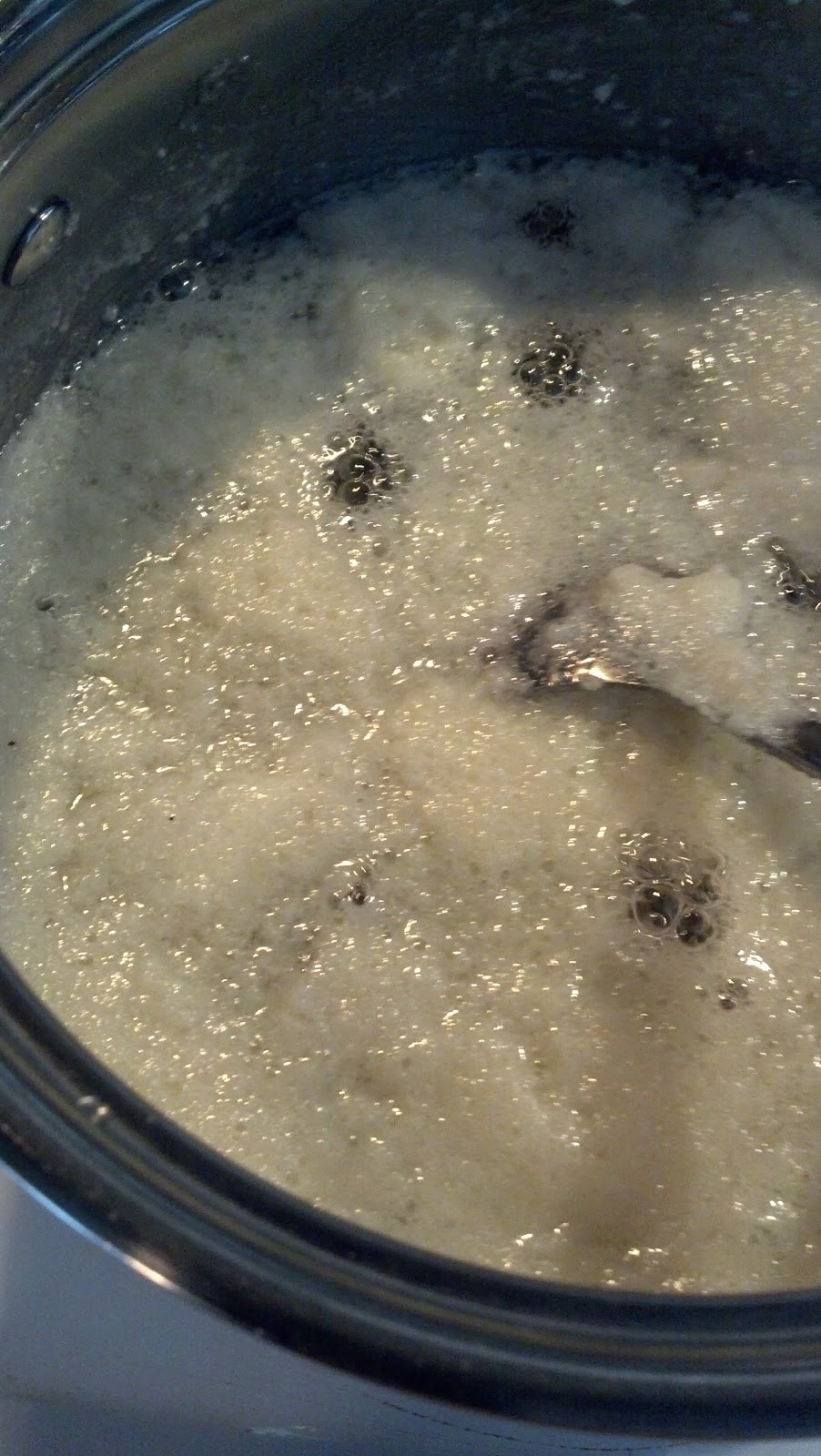
Boil 1 cup of water in a small thick bottom sauce pan. Add salt and oil and sprinkle in a tsp of ragi flour. Mix and bring everything to a boil and lower the heat to medium. Meanwhile mix the dry ragi flour in one cup of cool water and whisk into a homogeneous batter. Slowly pour this ragi batter into the boiling water, stirring simultaneously with a spatula (preferably wooden). Lower the heat further down. Continue to cook and stir for 6 to 8 minutes.The liquidy batter should gradually become thicker and become a soft dough. Remove the spatula, cover and  turn off the heat. Let it sit for a couple minutes before dividing into smaller
tennis ball sized dough or muddae/kali.
Almost cooked

Cooking Tips:

To divide and sub dive the hot ragi dough into balls, place some cooked ragi dough in a plate, dip your hands in cool water and shape the dough into balls for serving.

Serving tips:

Always serve ragi muddae/kali hot with a little dollop of ghee. It is usually served with hot sambar/huli or gojju.

Wednesday, December 4, 2013

Pasta with Roasted Asparagus

Pasta with Roasted Asparagus

Goat cheese and pasta

Ingredients:

  • 1 bunch asparagus (tough end trimmed and cut into 2" pieces)
  • 1 med onion cut length wise
  • 2 tbs butter
  • 1  1/2 cup short or any curly pasta
  • 1 small (5 oz) goat cheese log (animal rennet free)
  • 2 or 3 tbs chives snipped (optional)

Seasoning:

  • salt
  • 1/2 freshly ground pepper
  • 1/2 red chili flakes
  • 1/2 Italian seasoning
  • 1 tbs olive oil
Combine 1 tbs of oil, 1/4 tsp of  pepper, 1/4 tsp salt, 1/4 tsp red chili flakes to make olive oil mixture.

Method:

Preheat oven to 400 degrees
Roasting ready
Line a baking sheet with aluminum foil and place the asparagus and onion on it. Pour the olive oil mixture on the asparagus. Toss to coat the asparagus and onion with the olive oil mixture, spread all into a single layer on the baking sheet. Roast in the oven for 15 minutes.

While the asparagus is roasting, bring a large pot of water to boil and generously salt the boiling water. Add pasta and cook until al dente (per the directions on the pasta box). Drain, save 1 1/2 cups of pasta water
and return pasta to the pot..

Goat cheese sauce
In a medium bowl crumble the goat cheese, add the butter and 1 cup of pasta water. Season with  1/4 tsp red chili flakes, 1/4 tsp Italian seasoning, 1/4 tsp ground pepper. Whisk all into a smooth mixture. Add the goat cheese mixture and the roasted asparagus to the pasta in the pot.
Toss to combine, add more pasta water as needed for the sauce to coat
pasta. Garnish with chives.

Serving ready

Cooking Tips:

Adjust salt and seasoning as per your taste. Can also substitute asparagus with other veggies like  brussels sprouts, zucchini, bell pepper. To kick up the heat add sliced jalapeno peppers and roast with the veggies.

Serving:

Serve hot along with salad and garlic bread. 

Friday, November 22, 2013

Besan Ladu


Besan Ladu

Raw
Roasting ready
Roasted


Ingredients: 

  • 1 cup besan
  • 1/3 cup ghee
  • 1/4 tsp powdered cardamon
  • 3/4 cup sugar
  • 2 tbs crushed nuts (almonds and or cashews) optional

Method 1 (Microwave)

Mix
Combine besan, crushed nuts in a microwaveable plate. Mix in the ghee. Microwave on high for three minutes, stirring every minute. Continue to microwave for another minute as needed, stirring every 30 seconds.. Check to see if the besan mixture is nicely roasted. If the besan is thoroughly roasted good aroma emanates and the raw smell dissipates. Remove from microwave and allow it to cool. Then add the powdered cardamon, sugar and mix well. Microwave for another 30 seconds, divide into smaller portions, press between your palm and fingers and make golf sized balls. Makes about 10 ladus.

Making ladus

Method 2 (Stove top)

Combine besan, crushed nuts in a large pan. Mix in half of the ghee. Roast the contents on medium low heat for about 10 minutes till the besan mixture is finely roasted and the raw smell has dissipated. Cool, mix in sugar, cardamon and the remaining ghee. Then divide, press between your palm and fingers and make golf size balls. Lakes about 10 ladus. 

Cooking Tips:

Very important to have the besan mixture thoroughly roasted and toasted slightly golden brown. Can warm the besan mixture a little either in microwave or the pan, to bind the mixture into balls. If the sugar is coarse, run it through the dry blender and powder the sugar a little.

Serving Tips:

Serve as dessert any time of the day.

Thursday, November 21, 2013

Ravae Iddly/ Cream of Wheat Iddly

Ravae Iddly

Ingredients:

Roasted Ravae

  • 1 cup of ravae (cream of wheat)
  • 1/4 cup of chopped cilantro
  • 1/8" chopped ginger
  • 3 or 4 green chopped chilies
  • 1 tbs of urad dahl
  • 1 tbs of channa dhal
  • 1 tsp salt
  • 1 tsp of mustard seeds
  • pinch of hingh(optional)
  • pinch of turmeric(optional)
  • 3 tbs of oil
  • 2 cups of buttermilk
  • 1/2 tsp Eno salt
  • 1/2 cup grated carrot or cooked peas (optional)

Method:

Heat oil in a pan on medium heat. Splatter the mustard seeds and roast urad dhal, channa dhal, hingh and turmeric (dahls brown quickly). Then add ginger, green chilies to the pan followed by the ravae. Continue roasting/mixing on medium heat for maybe 5 to 10 minutes (the raw smell disappears). Turn off the heat and combine the grated carrots or the cooked peas and set aside to cool.

When cool, mix in 1 cup of buttermilk and salt.  Let sit for 5 minutes and this should make a pretty dense dough. Now add the remaining butter milk and mix the contents making sure there are no lumps and it is a pretty homogeneous mixture. Within a couple of minutes or so this should be a thick, pour-able consistency batter(pankcake batter consistency).

Simultaneously, bring about a cup of water to boil in a large steamer pot with a heavy lid, or use a iddly maker pot to bring water to boil and steam. When the water is boiling in the steamer, add Eno salt to the dough and thoroughly mix it in. Immediately, spoon the batter into the iddly maker plates. Assemble the plates on to the stand and place the stand in the steamer. Cover with lid and steam for 12 to 15 minutes. Remove lid and test the ravae-iddlies with a fork. If the fork comes out clean without wet dough sticking to it, then the iddlies are ready. If not continue to steam till the iddlies are cooked.

Using a cotton towel or tongs, remove the iddly stand carefully from the steamer and place on a cutting board or a plate. Let cool for a few minutes. Or run each iddly plate back and front, quickly through cold running water to cool. Then scoop out each cooked iddly carefully into a serving dish with a butter knife or a small flat spoon.

Cooking tips:

Add Eno salt just before steaming. The Eno salt when combined with buttermilk foams profusely, making the iddly soft and porous.When making several batches, add Eno salt separately for each batch. Instead of Eno can use 1/2 tsp of baking soda. Eno salt or baking soda should be airtight containers or else they loose potency/strength and the iddlies may urn out flat and not spongy.

Serving tips:

Serve ravae iddlies hot with a dollop of ghee, coconut chetni and potato sagu.

Butter Paneer Masala

Butter Paneer Masala

Butter Paneer Masala

 Ingredients:

  • 2 cups Paneer chunks (home made or store bought)
  • 1/2 cup peas (optional )
  • 1 tsp sugar
  • 1 tsp salt to taste
  • 6 cashews powdered (or 1 tbs corn starch mixed in with 1/4 cup of water)
  • 1 tsp cumin seed
  • 2 bay leaf
  • 3 tbs oil + 1 tbs butter (or 4 tbs of butter)
  • 1/2 cup cream(or whipped yogurt)
  • 1/4 cup cilantro chopped
  • 1/4 tsp garam masala
  • 1 tbs kasoori methi or fresh chopped methi leaves (optional)

Masala Mixture

  • 2 medium tomatoes
  • 1 green chili
  • 1 /4 " ginger grated
  • 1/2 tsp turmeric powder
  • 1 tbs coriander powder
  • 1/2 tsp chili powder
Puree/blend the tomato, chili and ginger together with 1/2 cup of water. Mix in the turmeric, coriander and chili powder and set aside

Method:

In a large non stick sauce pan heat the butter and oil on medium heat.  Add the paneer chunks and shallow fry, use a slotted spatula to flip the paneer every now and then. When the paneer looks slightly browned on most of the sides, remove them from the pan and place them in another dish.
Heat the remaining oil/ butter mixture in the pan. Splatter cumin seeds and add the bay leaves and twirl it around for a  minute. Then carefully add in the masala mixture to the pan. Cook till the raw tomato flavor dissipates and the oil kind a separates. Add the cream and simmer for 2 minutes. To thicken the gravy stir in the cashew powder or the cornstarch mixture. Simmer for another couple minutes. Then add the fried paneer, cooked peas peas and salt. ( PS. Either pre cook the peas and add it in or cook peas in the sauce till they are tender). Add little water if the gravy becomes very thick. Simmer all  for 5 minutes. Stir in sugar if the gravy is on the sour side. Add garam masala cilantro, methi and mix thoroughly. Turn off the heat.

Cooking Tips:

The gravy for this dish can be used as a base to make several other vegetables. One small chopped onion can be sauteed along with the bay leaves to make the dish more flavorful.

Serving Tips:

Serve with rotis or chappatis or naan.

Wednesday, November 20, 2013

Baklava

Baklava

Ingredients:

  • 1 box Phyllo dough (thawed per directions on the box)
  • 2 cups of nuts (almonds, cashews, pistas, walnuts, all coarsely powdered, not chunky)
  • 1/2 tsp powdered cardamon
  • 1/2 cup butter at room temperature or slightly melted
  • 1/2 cup sugar

 Syrup 
Baklava

  • 1 cup sugar
  • 1/2 cup honey
  • 1 cup water

Method: 

Preheat oven to 400 degrees.
Mix the dry ingredients (nuts, cardamon, sugar) in a bowl and set aside.

Then layer the butter, phyllo sheets and nut mixture as follows::

  1. Brush/smear butter on the bottom of a 11x17 glass dish (or a deep baking sheet).
  2. Use 5 or so phyllo sheets in bunches to layer the buttered dish .
  3. Brush/smear butter generously all over the top layer.
  4. Sprinkle about 1/2 the nut mixture evenly on the buttered phyllo.
  5. Repeat Step 2, 3 and 4 over the nut mixture layer.
  6. Repeat Step 2 and 3 for the final layering.
Finally use a sharp knife to score and cut the phyllo ensemble  into small squares or any shape and size desired. Bake in the oven for 20 minutes till the phyllo is golden brown. Carefully remove the baked dish from oven.
Prepare syrup while the dough is baking in the oven. To make syrup boil water, sugar, honey in a small sauce pan for five minutes and turn off the heat. Pour the entire contents of the syrup evenly over the baked phyllo. The sticky Baklava is ready to be served.

Cooking Tips;

Can use finely chopped dates, figs, raisins and other dried fruits along with the nuts. Use food processor to chop the nuts. Alternately, use 1 tsp of cinnamon powder, 1/4 tsp cloves powder instead of cardamon to vary the flavor.

Serving Tips:

Serve as dessert or at tea time.

Cauliflower Potato Sabji

Cauliflower Potato Sabji

Ingredients:

  • 2 cups of Cauliflower cut into large chunks
  • 2 cups potato cut into large chunks
  • 2 green chillies slit lengthwise
  • 1 bay leaf
  • 1/4 cup cilantro chopped fine
  • 1 tsp salt to taste
  • 1/2 tsp cumin seeds
  • 3 tbs oil
Masala Mixture
  • 1/2 tsp turmeric powder
  • 1 tsp coriander powder
  • 1/2 tsp chili powder
  • t tbs grated ginger
Mix all the masala mixture ingredients in 1/2 cup of water and set aside

Method:

In a large sauce pan heat oil on medium heat. Splatter cumin seeds, add the bay leaf and the green chilies and twirl it around for a couple minutes. Then carefully add in the liquid mixture and stir for a couple minutes.till good flavor emanates and the oil kind a separates. Now, add the potatoes, cauliflower, salt and another 1/2 cup of water to the sauce pan. Cover and cook on medium for 15 minutes or so till the potatoes are cooked, stirring every now and then. Turn off the heat, add cilantro and mix thoroughly.

Cooking Tips:

Add pureed or diced tomatoes with the cauliflower for a variation. Can also add peas in the dish. Saute a couple whole cardamon along with the cumin seeds to make the dish more flavorful. Or mix in 1/4 tsp garam masala at the end along with the cilantro for more kick. To make the dish with gravy, saute 4 pureed tomatoes with the spice mixture and add 1/2 cup of cream or whipped yogurt. If the dish is a little on the sour side, add a tbs of sugar.

Serving Tips:

Serve with rotis or chappatis or naan.

Lemon Pickle Simple


Diced and salted lemons

Lemon Pickle Simple

Ingredients:                                                        

  • 6 large lemons diced small 
  • 1/8 cup chili powder
  • 1/4 cup salt
  • 2 tbs methi seeds 
  • Spices
  • 2 tbs mustard seeds

Garnishing Ingredients:

  • 1 tsp of mustard seeds 
  •  1/4 cup corn oil
  • 1/4 tsp turmeric
  • 1/4 tsp powdered hingh


Method:

Powdered spices 
In a ceramic dish thoroughly mix the diced lemons, ginger, salt, cover and set aside for a couple of days. Mix in the chili powder. Dry roast the methi seeds and the mustard seeds separately. Cool and dry blend into a coarse mixture. Add  this mixture to the saucy lemon mixture in the ceramic dish. Mix thoroughly and let it all sit for a day or so.
To garnish heat oil in a saucepan on medium and splatter the mustard seeds. Add hingh and turmeric and turn off the heat. Add the cut green chilies and swirl it around in the hot oil. Then pour the contents into the ceramic dish and mix well.  Let the pickle sit in the ceramic dish for a couple days before storing in glass or ceramic container with a tight lid. 

Cooking tips:

Garnished 
These pickles will last several months without refrigeration. Initially the lemon pieces will be crispy, but after a few day the lemons will become tender. Always make sure to use clean and dry utensils to serve the pickles.A little additional sprinkle of additional salt every time the pickle container is opened, goes a long way to extend the shelf life of the pickles. Adjust the amount of salt and chili powder as needed. Couple of green chilies, diced pieces of bitter gourd can be added along with the garnish

Serving:

Serve with rice, rotis, yogurt

Monday, February 4, 2013

Parwal Sabji

Cut Parwal and Potatoes and masala

Parwal Sabji

Ingredients:

  • 2 cups of parwal cut into large chunks
  • 2 cups potato cut into large chunks (cleaned and peeled)
  • 1/4 cup roasted peanuts ( ground into a coarse mixture)
  • 2 tbs besan flour
  • 1/4 cup cilantro chopped fine
  • 1 tsp salt to taste
  • 1/2 tsp cumin seeds
  • 
    Ground peanuts, besan and cilantro
    2 tbs oil                                
 
Masala Mixture
  • 1/2 tsp turmeric powder
  • 1 tsp coriander powder
  • 1 tsp chili pwder
  • 1/2 tsp garam masala
Mix all the masala mixture ingredients in 1/2 cup of water and set aside


Method:

Sabji
In a large sauce pan heat oil on medium heat. Splatter cumin seeds and add the liquid masala mixture and give it all a twirl for a couple minutes. Add the potatoes, parwal, salt and another 1/2 cup of water to the sauce pan. Cover and cook on medium for 15 minutes or so till the potatoes are cooked (slightly soft). Mix in the ground peanuts and besan. Turn off the heat, add cilantro and mix thoroughly.


Cooking Tips:

If the parwals are not tender scrape of the skin with a blunt knife or just peel the skin. if the inside seed core is orange in color or if the seeds are substantially formed these need to be removed before cooking.

Serving Tips:

Serve  with rotis or chappatis or naan.

Monday, December 24, 2012

Sakkarae Achhu/Sugar Candy

Sakkarae Achhu

Ingredients:

  • 3  cups sugar
  • 1 cup water (just enough to submerge sugar)
  • 1/2 cup whole milk
  • 1/2 cup yogurt(homemade or store bought)
  • 1/2 a lemon
  • 1 large piece of cheese cloth( any thin cotton cloth)
  • 3 tbs of sugar candy/kallu sakkarae (optional)
Soaked sugar

Curdling syrup

Straining syrup

Wringing to Strain syrup


Method:


Strained syrup plus rind
In a large sauce pan soak sugar and kallu sakkarae with just enough water to submerge all of the sugar. Let it sit for an hour or so. Then place the pan on the stove and simmer the syrup on medium heat to melt the sugar content properly. When the syrup starts to boil thoroughly, mix in the milk. When this mixture begins to start foaming and boiling over, mix in the yogurt. Let  this mixture curdle, foam and boil over again and then squeeze in a little lemon juice ( about 1 tbs). Bring this syrup mixture to a good simmer and boil which will make the contents to separate and curdle even more. Turn off the heat.
Wet and thoroughly wring out the cheese cloth. Line a small mouth, tall  vessel with the cheese cloth and strain the syrup mixture carefully in it. Store the strained syrup to make sugar candy. Throw out the rind inside the cheese cloth.
Simultaneously, clean and place wood sugar moulds in a bowl of water. Remove these from water, tap on the outer to remove excess water in the moulds. Season the molds with a little oil or oil spray (Pam).  Use rubber bands to hold the two pieces of moulds together. Place them on parchment lined large plate or counter for easy clean up. The moulds are prepped to receive the sugar candy syrup.

Place a small bowl of cold water near the stove, to test the readiness of the sugar syrup during the candy making process.

Sugar syrup boiling

Prepped wooden moulds

Sugar candy/acchu in the moulds


Sugar Candy/Sakkarae Acchu making process:
  1. In a small thick bottomed sauce pan heat 1 cup of the strained syrup on low heat and let it boil slowing for a several minutes, constantly stirring with a large spoon.
  2. 
    Sugar Candy/Acchu
    If the syrup starts to foam a lot, it needs to be taken out of the heat and stirred thoroughly. Place the syrup back on the stove and continue to stir constantly. Continue this process on and off till the sugar syrup thickens.
  3. Place a drop of the syrup in cold water and if the syrup makes a firm ball then it is ready to be spooned into the prepped moulds. **
  4. Spoon in the syrup into the moulds. Let cool for 5 to 10 minutes and remove the rubber bands from the moulds.
  5. Using ta butter knife or a blunt knife scrape off any excess dried on sugar syrup from the moulds.
  6. Pry open the moulds and let the sugar candy /sakkarae achhu air dry for a few minutes.
  7. Carefully remove the sugar candy from the moulds place them in a large plate to be stored in airtight containers later when completely cool.
Repeat the process from step 1 to finish all the cleaned and strained sugar syrup. The scraped and broken pieces can be added to this.

Cooking Tips:

Using the same small sauce pan, with all its dried on sugar candy in it and the scraped and broken sugar candy pieces, will help speed up the sugar candy making process. With this, there is also a tendency for the sugar candy to brown. Low heat is key to make whiter sugar candies. Can use food colors of your choice.

** no mould sakkarae acchu
**If you do not have wooden sugar moulds, pour/spoon the syrup on to a well greased aluminum foil or lightly greased parchment paper lined plate. Let cool for 15 minutes or till fairly cool. Cut it up  into bite size pieces  for consumption. Or cut into smaller 1/4" square pieces and use in Sankranthi Yellu mixture or any of your own trail mixes. Can also use hard candy moulds instead of the wooden moulds.

Serving Tips:


Distribution ready
Traditionally made during Makra Sankranthi festival (Mid January) and distributed to family and friends along with fruits, sugarcane and sankranthi yellu.

Sankranthi Yellu

Sankranthi Yellu

Ingredients

Ingredients:

  • 1/2 cup white sesame seeds (the husked, cleaned variety preferable nylon yellu)
  • 1 cup raw peanuts ( smaller variety)
  • 1 cup roasted channa/hurigadalae/dalia
  • 1 cup coarsely cut jaggery
  • 1 cup dessicated large coconut flakes
(Scour through all the ingredients, separately to clean and remove any stones, twigs and unwanted items.)


Method:

Pre heat oven to 320 degrees.
Line a 11 x 17 baking sheet with parchment paper or aluminum foil.

Ready for roasting
Through dry and keep a large bowl ready.
  1. Spread the sesame seeds on the baking sheet in a single file and bake in the oven for 6 to 8 minutes. Place the lightly toasted sesame seeds in the bowl. 
  2. Similarly, spread the peanuts on the baking sheet  in a single file and bake in the oven for 15 to 20  minutes. Remove and place the toasted peanuts in a large plate and let it cool. Loosen the husk from the cooled toasted peanuts by rubbing between your hands forcefully. Also split up the whole peanuts into halves(cotyledons) in the process. Remove and clean the husks and the nodules(radicle) that held the cotyledons together. Add the cleaned peanuts to the bowl.
  3. Then spread the coconut flakes on the baking sheet and  bake in the oven for 3 minutes. This is just to warm the flakes a little bit to bring out the flavor (this step can be skipped). Add the coconut flakes to the bowl. 
  4. Mix in the cleaned roasted channa and the coarsely cut jaggery to the bowl.
Store in air tight containers.

Mixing bowl

Variety Yellu w/ peppermint and kasuri kalu
Distribution ready


Tips:


Skinning kobbari


Slicing/cutting kobbari
Cutting sakkarae acchu


Traditionally, dry coconut (kobbari gitaku) is skinned and cut into small pieces and use instead of the coconut flakes. Also, peanuts and yellu can be roasted on stove top in a large pan. Peanuts should be toasted till they start popping on medium heat. Yellu/sesame is toasted on low heat till they crackle and  balloon up a little. Home made sugar candy (sakkarae acchu see blog) can also be broken into small pieces and used in the sankranthi mixture instead of jagerry. It is also common to use jeerigae (cumin) peppermint or and kusari kalu in this mixture. Only firm jaggery (less moisture content) cut into small pieces should be used. Store in airtight containers. Will keep for several weeks. Vary the quantities of the ingredients per your taste.

For a twist you can make this into a trail mix add chocolate chips and nuts of your choice. 


Serving Tips:

Distributed to friends and family along with sugarcane, sugar candy (sakkarae achu) during Sankranthi festival.

Sunday, December 16, 2012

Fresh Coconut for Cooking


Coconut

Fresh Coconut for Cooking

Ingredient:

  • 1 whole coconut

Method:

Remove any excess fibers on the coconut. Rinse under running water. Crack the shell by hitting the coconut in the middle. Use a hammer to firmly tap around (equator) the coconut forcefully or using full force beat the coconut on a stone or concrete surface to crack the shell. Try and reserve any coconut water in a cup before continuing to break open the coconut to reveal the white core. The core should be firm without being moldy or foul smelling.

Then the core can be grated with different kinds of coconut graters and freezed in plastic bags for future use in dishes.

If you do not have a grater follow steps below.

  1. Break and shell the coconut further with a hammer and remove the white coconut core with a butter knife.
  2. Peel the dark stiff skin with a grater or a sharp knife.
  3. Slice the peeled coconut into 1/4" thin slices and freeze in plastic bags for future use in dishes.
  4. Or using a food processor, chop the slices into small gratings and store in freezer in plastic bags for future use in dishes.
Step 1

Step 3

Step 2

Buying Tips:

The coconut should not have any visible cracks or leaks, or be soft at the eyes spot. When tapped with a coin the sound should not be dull.

Using Tips:

Coconut gratings can be used in many dish especially in Curry's (palya/karmind), saaru/rasam etc. It is blended to be used in payasa, huli/koimbu, kootu etc.

Thursday, December 13, 2012

Matod/Parp Usali

Matod/Parp Usali


Matod
 
Blended dhals

Ingredients:

  • 2 cups of diced cluster beans/gori kai/kottorangai or methi leaves/mentya soppu
  • 1 tsp of salt
  • 1/8 cup of corn oil
  • 1 tsp of mustard seeds
  • 1/8 tsp powdered hingh
  • 1/8 cup chopped cilantro (optional)
  • 1/8 tsp turmeric
  • 1/4 cup thoor dhal
  • 1/4 cup channa dhal
  • 1/2 cup freshly grated coconut
  • 4 red hot peppers

Method:

Soak thoor dhal and channa dhal for an hour or so. In a food processor run the coconut and hot peppers for a couple minutes. Decant all the liquid from the soaked dhals and add it to the food processor. Run the food processor on medium to just break up the dhals into coarse pieces. Transfer into a smaller dish and steam (just like iddlies) for 15 minutes. Take the dish out of the steamer and run a fork through the steamed dhals to break up any clumps. (PS. this step can be skipped and the dhals can be cooked right in the pan).

Heat oil in a pan on medium heat and splatter mustard seeds. Add hingh, turmeric, cilantro, vegetables and cook in very minimal water, till almost tender (or just pre-cook the vegetables separately, decant the liquid and add it in). Then add the blended dhals. Continue to cook, mix and flip the contents around constantly for 10 minutes or more, till the dhals are cooked. It is very essential to thoroughly cook the dhals. Mix in the salt and turn off the heat.

Cooking tips:

Use oil generously to avoid the dhals crusting up at the bottom of the pan quickly or use a non stick pan to make this dish. Other vegetables like green beans, long green beans etc can be used in this dish.

Serving tips:

Serve vegetable curry with rice, rotis, pocket pits and breads.

Tuesday, December 4, 2012

Banana Pie

Banana Pie


Ingredients


Ingredients:

  • 1 no bake graham cracker pie crust
  • 5 ripe bananas sliced
  • 2 cups whipped cream (see below to make your own whipped cream)
  • 1 can condensed milk
Pie with chocolate wafers & walnuts
Decorate (optional)
  • 1/3 cup walnuts/pecans
  •  7 chocolate wafers
  • Fruits (banana slices, strawberries, mango slices)

Method:

Toffee syrup:
Peel label from the condensed milk can. Immerse the unopened can in a pot of water and bring it to a slow, steady boil for 3 to 4 hours. Make sure that the can is always completely submerged in water by adding more water, as needed, through out the process. Remove from water and cool before opening the can for the toffee syrup.

Pie:
Remove the plastic from the pie crust. Carefully add and spread the toffee syrup (it is pretty viscous) at the bottom. Then layer the sliced bananas to the rim of the pie crust. Top with whip cream and chill in the refrigerator.

Decorate:
Sprinkle nuts and decorate with chocolate wafers, fruits of your choice.

Cooking Tips:

Substitute or add other soft fruits of your choice like mangoes, peaches. Make toffee syrup and whipping cream in advance. Unopened toffee should keep for several weeks.

Serving Tips:

Serve as dessert.
                                        ~~~~~~~~~~~~~~~~~~~~~~~~~~~~~~~~~~~~~~~~~~~~

Whipping Cream

Homemade whipped cream can be made in less than 15 minutes. 1 cup of whipping cream wil yield 2 cups of whipped cream. Utensils and the beaters for making the whipping cream should be chilled in a freezer for at least 15 minutes prior to using them to make whipped cream. The whipping cream should also be stored in the coldest part of the refrigerator.
Remove the mixing bowl and beaters from the freezer after sufficiently chilled. Be sure to use a bowl big enough to hold the cream once it is whipped. Cream will double in volume. It is also best to use a bowl that is narrow with deep sides.
Add 1 cup of heavy cream in the chilled mixing bowl and beat with a hand mixer/stand mixer for 20 to 30 seconds on low until bubbles begin to form.
Increase mixer speed to medium and beat until the cream begins to thicken and the beaters show a slight trail in the cream.
Increase mixer speed to high and beat until the cream begins to thicken and puff up. Slowly add 2 tbs of powdered sugar and any desired flavoring, off to the side of the bowl and continue beating.
Continue to beat the cream until it forms a soft peak. For a soft peak, beat until a soft curved peak forms when pulling the beaters straight up out of the mixture. For a spreadable whipped cream or a stiffer peak, beat for another 20 to 30 seconds.
DO NOT over whip the cream. If the cream is over whipped it will start to separate and curdle.